- The Dosage
- Posts
- How to know what you want to do in life (my discovery journey)
How to know what you want to do in life (my discovery journey)

Mat Do
October 27, 2023
After I was let go from my 9-5,
something I’d been actively working toward for over 7 years including education and internships – I was immediately confronted with the daunting task of
“figuring out what I want to do for the rest of my life.”
Yeah, no pressure.
The only problem is that “figuring it out” is an extremely vague endeavour.
A vague goal led to vague plans, which led to vague actions, which led to me sitting on the couch one day, high on something, holding back tears I’ve probably had since the sixth grade.
I didn’t want to admit it as a 28-year-old adult, but amidst my existential crisis, I had absolutely no idea:
Who I was
Where I was
What I wanted to do
How I was going to solve it, or
When things will be normal again
I always prided myself on being that guy who ‘always had a plan’ so experiencing a state of complete disorientation truly overwhelmed me.
It was the first time I sincerely prayed to God as a “non-believer” to give me something, anything. It was one of those “GIVE ME A SIGN” moments you see in movies. To top it off, it was bucketing down with rain to add to the melodrama.
As cliché as it sounds, in my humility, I had a realisation so stupidly obvious I wish I could travel back in time and slap myself in the face.
All those things I was pondering – the who, what, where, when, & how – were questions, and on the other side of a question is an answer. That’s just simple logic.
No matter how big the question is, with persistence, it can be drilled down to the point of being too obvious to miss. For me, this had to be the starting line.
If I’d been walking the False Path this entire time, then surely that meant that a True Path had to also exist.
For the next 6 months, I went into full “Monk Scientist” mode – a combination of the focus of a monk and the curiosity of a mad scientist. I unplugged all social media, uninstalled all my video games, and blocked off all contact with my friends and family members.
The only thing I had to keep me company was my 18-month-old dog Jaeger.

The Path to Purpose: My Journey to X
Before we dive in, I want you to know right off the bat that finding something as grand as your life’s purpose doesn’t happen overnight.
I’m not declaring I’ve got it all figured out and from experience, it has been a slow, gradual, and experimental process of trial and error.
Even if God himself knocked on your front door with the perfect script, you’d most likely scrunch it up and grab an extra padlock.
The reality is that opportunities are abundant, but our minds, awareness, and perspectives aren’t primed to seize the right opportunities even if they slap us in the face.
If you told me a year ago that I’d be writing articles every week, growing an audience on X, building meaningful projects, and connecting with ambitious like-minded people – all while having the time of my life, I’d call you a liar.
NONE of this could have been possible without my portfolio of failures and pivots (7 to be exact) to form the baseline awareness necessary to recognize an opportunity and seize it.
Here’s a birds-eye view of my journey during this period of disciplined focus. I call it the Xmas tree due to its dynamic nature and shape. It also illustrates quite nicely that discovering one’s purpose is not a linear equation.

Each zig and every zag represents a pivot, based on an informed decision through a frame of reference. This frame of reference – let’s call it our inner compass – is the foundational answer(s) to the big questions I previously mentioned during my existential meltdown (more on that later).
You can see that with each pivot, the path narrows, getting closer in alignment and eventually landing on something I find meaningful and fulfilling.
I’m not saying that your path will look identical to mine, but by investing in my portfolio of failures, I began to build a clearer vision of what the True Path looked like for me.
You can do the same.
Let’s quickly run through each point so you can get a better idea of what I’m talking about.
Computer Science (CS50 – Harvard)
After I was let go, I immediately bought and enrolled on an online computer science course offered by Harvard.
My logic was that technology was the future and if that was going to be the new normal, I’d better learn the language and make bank like everyone else in the industry.
Like a prisoner who only knows how to make a living one way, upon being “released”, I immediately defaulted to the same motivations that got me into “prison” in the first place.
Money, security, comfort.
After realising I could barely keep my eyes open beyond the first module, I knew I had to slam the breaks, hit factory reset, and uninstall all the malware that had taken refuge on my operating system.
This was the first pivotal moment that catalysed my transformation.
Blockchain course
After CS50 I started looking into Blockchain technology.
It was during this time when crypto was going ballistic and I’d always been curious about bitcoin and the future of digital currency.
From one course to another, I bought and enrolled on an entry-level Blockchain course in the hopes of becoming an authority in a specialized and growing niche.
As you can see, even though I pivoted from the broader field of computer science to a narrower niche in blockchain – I was still more or less making the same mistakes, pursuing a novel way to gain a quick buck.
Once again, after taking the course, it just didn’t align with my compass – I decided to make my second pivot.
Web 3.0 Sales Development Representative
Okay, you can see my determination with tech at this point, moving from the blockchain itself and opening it up to the Web 3.0 ecosystem.
You can also see I was beginning to become more aware of the essential skill to make money – the ability to sell.
It was also at this stage that I began to ditch the whole course thing and take a more practical approach. Sales is one of those things where you learn by doing so I started to look for jobs online.
I was actually pretty determined on this one. I overhauled my CV, LinkedIn profile, and wrote personal letters to start-up tech CEOs from around the world.
Looking back, I’m so glad I got rejected by every one of them as packing up my bags and moving across the world just wasn’t the right play in hindsight. But I’m glad I tried.
Masters of Business Administration / Graduate Diploma in Philosophy
I’m so extremely grateful for these next two. This experience taught me one of the most valuable lessons:
The times you need advice the most, are the times you need to avoid other people’s advice the most.
One of my close friends during this time was going through something similar. He was uncertain of his future and weighing up his options, so naturally, we’d exchange ideas.
A key thing to note is that his mind and view on life are almost polar opposite to mine. He is huge on the education and academic system and an aspiring professor.
However, what tends to happen is our biases rub off, even if out of our good nature. It got to the point where I was researching universities that offered MBAs and/or Philosophy courses.
The influence was so strong I was even communicating with a coordinator from the Australian National University (ANU) in Canberra.
Once again, it misaligned with my compass, and I was reminded of my deep entrepreneurial yearning – completely antithetical to reintegrating back into the school system. I regained my bearings and made yet another pivot – this time, however, it would last much longer than the previous ventures.
Freelance Copywriting
This was when I started to feel like I was on the right track. I had never heard the term copywriting before and like most people, thought it had everything to do with copyright laws.
I only became aware of it through the research of MBAs – which goes to show that the answers you need often present themselves in weird, unorthodox ways.
By this point, I knew I wanted to lean into entrepreneurship, I knew that selling was a core skill that I needed to develop, AND I was already writing every day to document my journey – freelance copywriting felt like the right play.
I completed a 14-day copywriting boot camp and immediately started cold outreach. I knew it wasn’t going to be easy, but holy shit, a newfound respect for my freelance brothers and sisters – the hustle is real.
Long story short, after working for a particular client for over 10 weeks without getting paid a single dollar, I was seriously on the brink of throwing in the towel. While I was despairingly doing my routine prospecting for clients, I happened to be on YouTube (not my typical prospecting platform of choice) and found my man.
One-person business – Dan Koe
The man was saying all the right things. It was as if every word was connecting all the floating nodes of information I’d been accumulating to this point.
Without my prior failures, I strongly believe I would have either discarded what he was saying or not been able to comprehend the information to the point where I’d take action.
Everything seemed to align with my compass and I didn’t need a lot of convincing to dive deeper and start my X journey.

While most people stumble on new information to start, it is your portfolio of failures that will make you stay.
How to discover your inner compass
First, what is a compass?
A compass is what explorers use as a frame of reference to guide them through uncharted territory. A compass is dictated by the Earth’s magnetic field, causing the needle to remain oriented towards a stable point.
The same principles apply to our inner compass. The stability of our needle is vital in an ever-changing world. There are 3 steps to discovering and applying your inner compass:
Self-interrogation
Painting the picture
Call to adventure
Let’s break each one down.
The Art of Self-interrogation
Ask and you shall receive
Seek and you shall find
Knock and it shall be opened
– Matthew 7:7
The difference between people who have a compass and those who don’t – is alignment.
Think about it, when a business is contemplating a large financial decision, they don’t simply “do it” as most self-help gurus tend to preach – but rather, they assemble board members and other key stakeholders to align their views, values, & goals to make an informed decision.
Don’t get me wrong, there are times when the sentiment to “just do it” is the right play, but when confronted with big decisions where the stakes are high, it is imperative to get your ducks in order to mitigate the risks that come with uncertainty.
Self-interrogation is the art of asking yourself the right question for the right occasion.
I know it sounds obvious, but you’d be surprised just how often we invest time & resources in solutions to non-existent problems. We get so hung up on getting immediate results that we lose sight of why we’re doing what we’re doing in the first place.
Our efforts must first be focused on defining the right frame, and the desired results will naturally follow. I’ve wasted months working on things that ultimately didn’t matter – if I were to do it all over again, these are the four things I’d focus on:
1. Understand your character traits (personality)
Most of us do personality tests as a bit of fun, but then resume daily life without a second thought. A personality test isn’t the be-all and end-all, but it sure as hell is a good place to start. Knowing what your “base stats” are, is a great way to form a baseline understanding of areas in life where you’d naturally excel.
→ Take the MBTI personality test
You can explore the MBTI (free) yourself and you’ll learn specific elements in relationship to your archetype such as strengths/weaknesses, workplace habits, career paths, etc.
I also completed the Big Five Personality test (paid) which gave me a better understanding of the five traits of agreeableness, conscientiousness, extraversion, neuroticism, & openness.
As an example here are my reports:
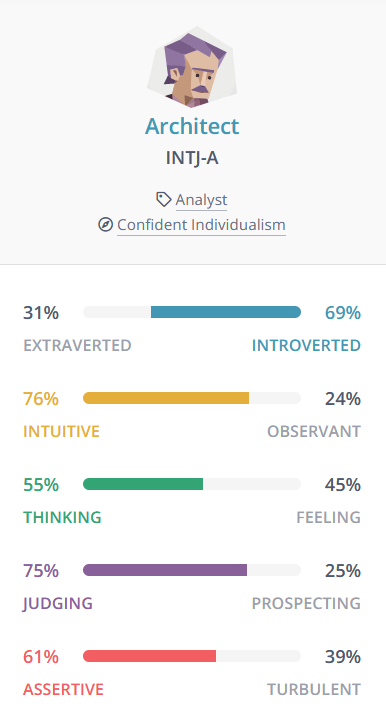
MBTI
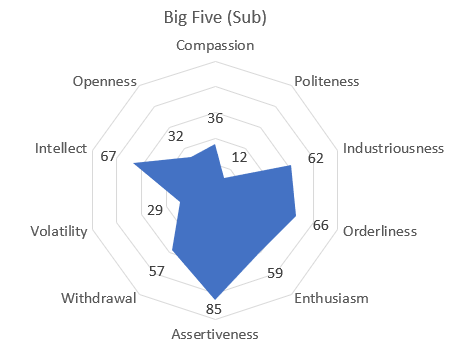
The Big Five (sub traits)
2. Learn what you’re naturally good at (strengths)
We’re commonly taught to “work on our weaknesses” but those at the top of their game do the complete opposite. Rather than fighting against the tide they instead double, triple, and quadruple down on their “God-given talents”.
There are things you do so well it feels completely natural, while other people struggle with the same task. I’m not saying to ignore your weaknesses altogether, but it would be insane to not take advantage of the things that give you a real edge in life.
A key note is that strengths are not to be confused with skills. Skills are acquired whereas strengths are innate. Skills that separate you from the pack are built on the foundation of your strengths.
Personally, I completed the Clifton Strength test (paid) and I still review my report to this day as it is highly comprehensive and actionable. (summary picture below).
If you’re not keen on spending, I did also complete the HIGH5 test which gave very similar results to Clifton Strengths. However, the free portion only shows your top 5 and the full report is behind a paywall just as a heads-up.
I highly recommend investing (it cost me about 3 and a half meals) in this knowledge. We spend money on all kinds of crap that eventually expire.
Foundational knowledge never expires so long as you persist with it, and I am bullish on the idea that understanding your strengths is an ever-appreciating asset that grows exponentially.

A summary report of my top 10 strengths
3. Discover what interests/excites you (curiosities)
There's a reason why most of us look back on our childhood with fondness. Back then, life was all about exploration and discovery – everything was new and exciting as if the entire world was our playground.
When we’re genuinely interested in something, the speed of our learning becomes almost superhuman. When we learn out of joy, our skills match that intensity – and we quickly build a portfolio of skills others can only dream about.
Before diving into the following questions, I want you to separate the likeability of something because of its utility, and instead focus on the raw love typical of an innocent child. This will help you get out of your way when answering.
Ask yourself:
What would you want to learn more about, even if you had to pay for it?
What kind of books do you enjoy reading?
(If not books; podcasts, videos, etc.)
What is the “thing” or “genre” that moves you?
What jobs in the world do you truly appreciate and want to give thanks?
What things in the world anger you, and want to see change?
DON’T OVERTHINK – set yourself a time, brain dump and move on.
4. Clarify what you find most important in life (core values)
Everyone’s heard the phrase “You are what you eat”, but even better than that is the lesser-known “You are what you think”. What you find most important in life, influences the entire set of structures and behaviour patterns that your identity binds itself.
There’s a reason religion, politics, and social issues dominate mainstream news. It is a never-ending war on what values are most important and whose system of governance is superior.
On an individual level, it is imperative to have clarity on your own personal hierarchy of values. It is what makes you, you – not your job, not your group, not your culture. Living out what matters most to you, is how you become truly irreplaceable in life.
Ask yourself:
Name someone(s) you truly admire/respect, what is it about them you admire, and why?
What experience in the past made the biggest impact on you as a person, and why?
What do you feel we lack in today’s society?
(Ask people close to you) “What do you think I value in life?”
What important life advice would you give to other people to follow?
DON’T OVERTHINK – set yourself a time, brain dump and move on.
Painting the Picture
By now you should have a bunch of scattered documents and scribbles – you may even feel a bit overwhelmed. Seriously, don’t stress. As Abraham Lincoln once said:
“Give me six hours to chop down a tree and I will spend the first four sharpening the axe.”
We are merely sharpening our axe.
In this step, we’re going to review each document and circle, underline, and note any “magic words” that pop out. These are the keywords or sentences that you see on repeat, that trigger a kind of excitement that grips you.
For me, a repetition of the words: entrepreneurship, persuasion, futuristic, independence, and strategy, continued to pop up and pull me in.
None of this is an exact science. It will take some conscious effort and time for these ideas to internalize into your subconscious and feel natural.
I recommend spacing out this step from the previous one with some sleep. Whilst self-interrogation focuses on a more convergent way of thinking, painting the picture is more divergent – relying more on intuitive feeling over rational deduction.
Call to Adventure
I’m an overthinker.
I tend to dive so deep to the point of diminishing returns. These return signals of anxiety which prompts me to think deeper and the cycle of mental masturbation continues.
If you’ve made it this far and actually are interested in applying the things I’ve preached, this last step is how you prevent entering a vicious cycle of planning without action.
Remember, it took me 7 pivots to eventually land on something – this all with the knowledge of my inner compass.
As soon as you’ve developed a minimum baseline, I highly encourage you to pursue like no tomorrow. Experiment, take risks, and iterate over and over until you find that one thing you cannot live without.

A leap of faith is impossible to avoid if you seek adventure – but you can rest knowing that your decisions are built upon a foundation of your best interest at heart, not somebody else’s.
I hope you found this insightful, and thank you for your invested attention.
— Mat